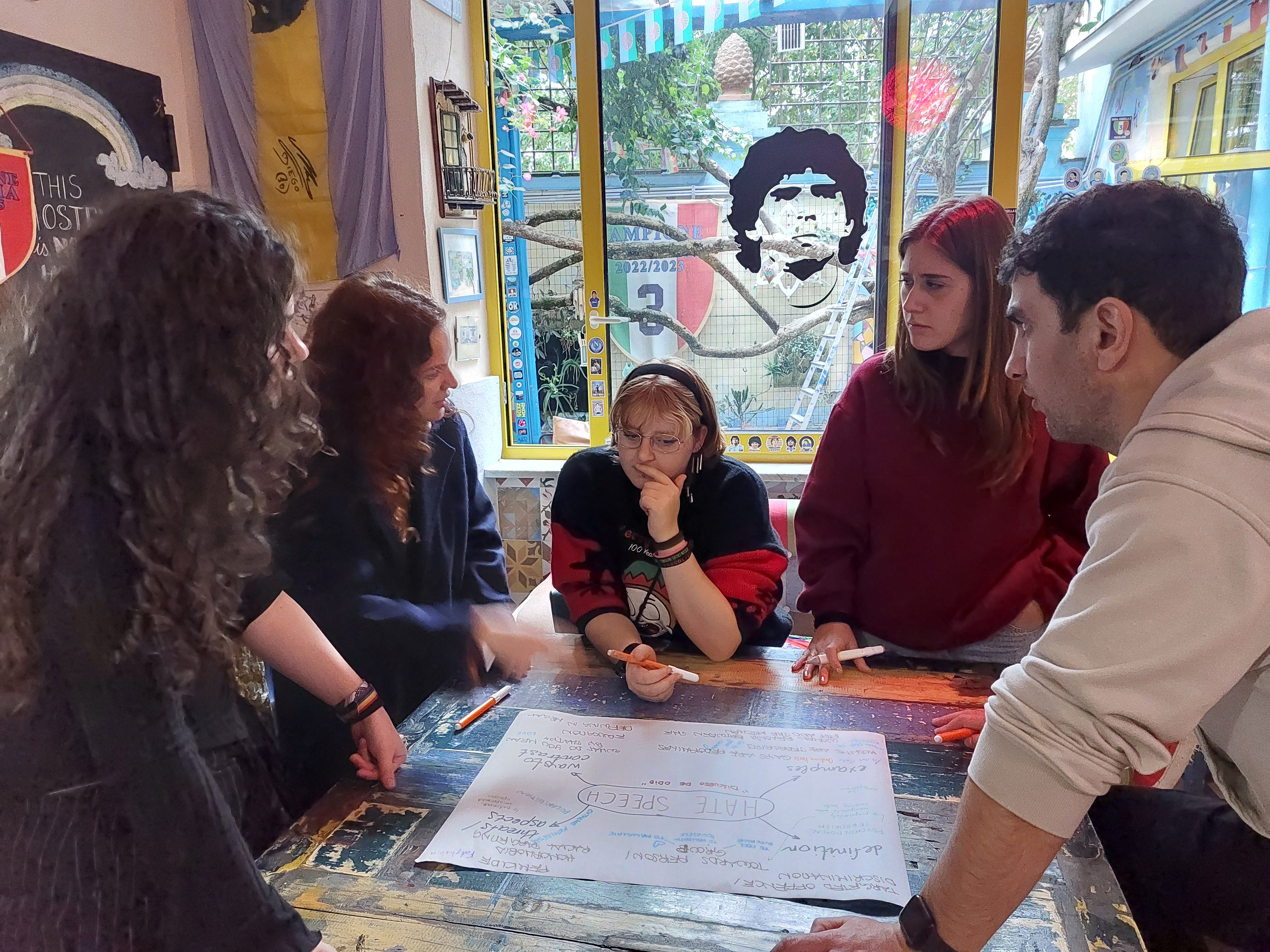


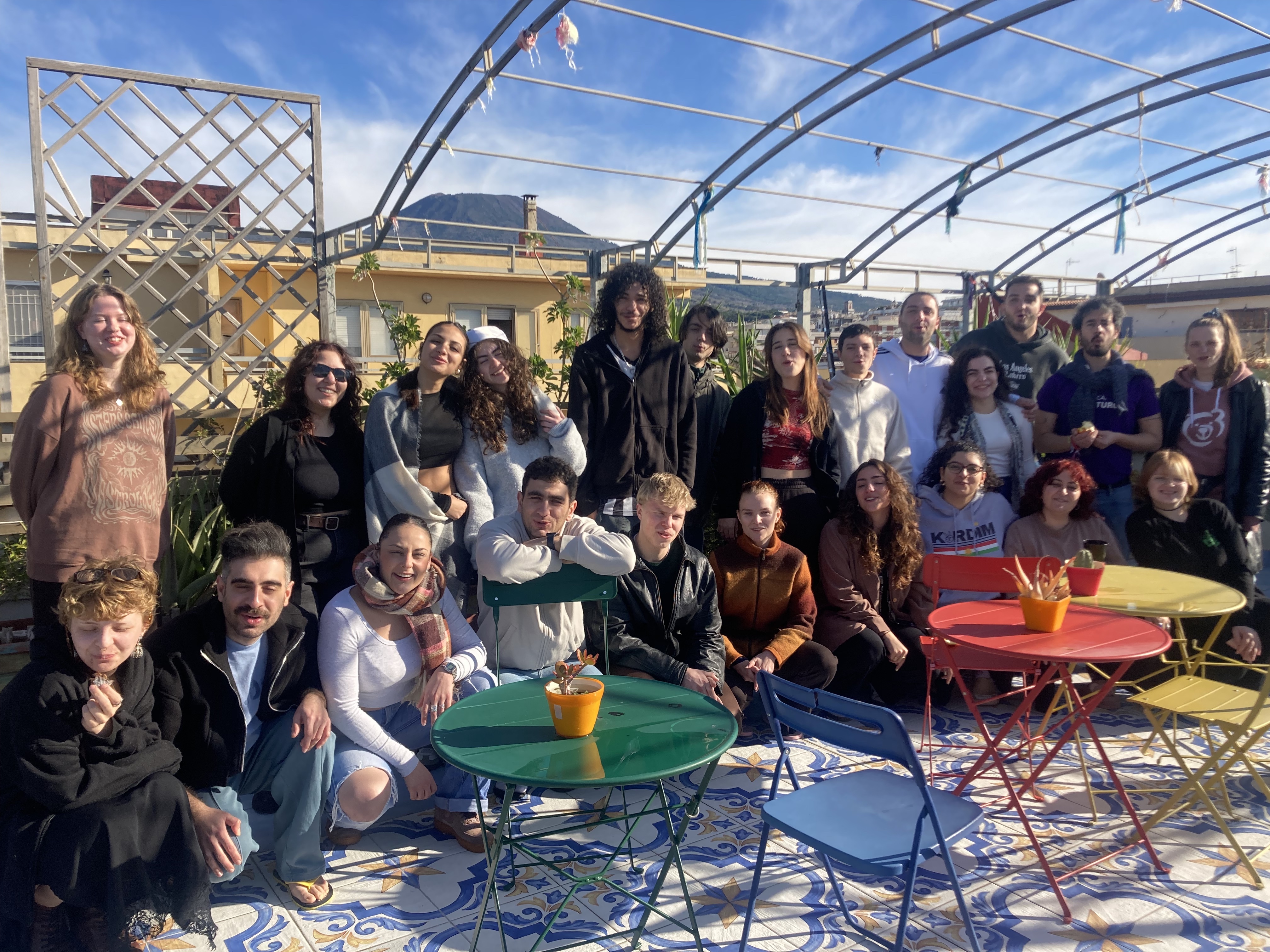
Imagine a week in November in the small Italian town of Ercolano near Naples. You live in an eco-hostel with four cats and about twenty other people. The rooms are full of bunk beds. The doors to the toilets and showers cannot be locked. The roof terrace opens up to a view of the undulating Mediterranean Sea and the Vesuvius volcano. The spaces are full of colorful paintings. The walls of the bar are adorned with dozens of pictures of Diego Maradona, even some of him as Che Guevara. A cheerful man named Andrea bustles in the kitchen, filling the crowd with pasta and other delicacies. In the evenings no one wants to go to bed. The soundscape is made up of noisy and enthusiastic speech. The weather is rainy for four days, and sunny for another four.
The official name of the week is The Age of Discontent, and it is an Erasmus+ Youth Exchange. We at Finnish Peace Defenders were pleased to be a partner in the project. The main coordinator was the Italian organization TwoPlusTwo, and other partners included Strait Up from southern Spain and DiverCity from Yerevan, Armenia.
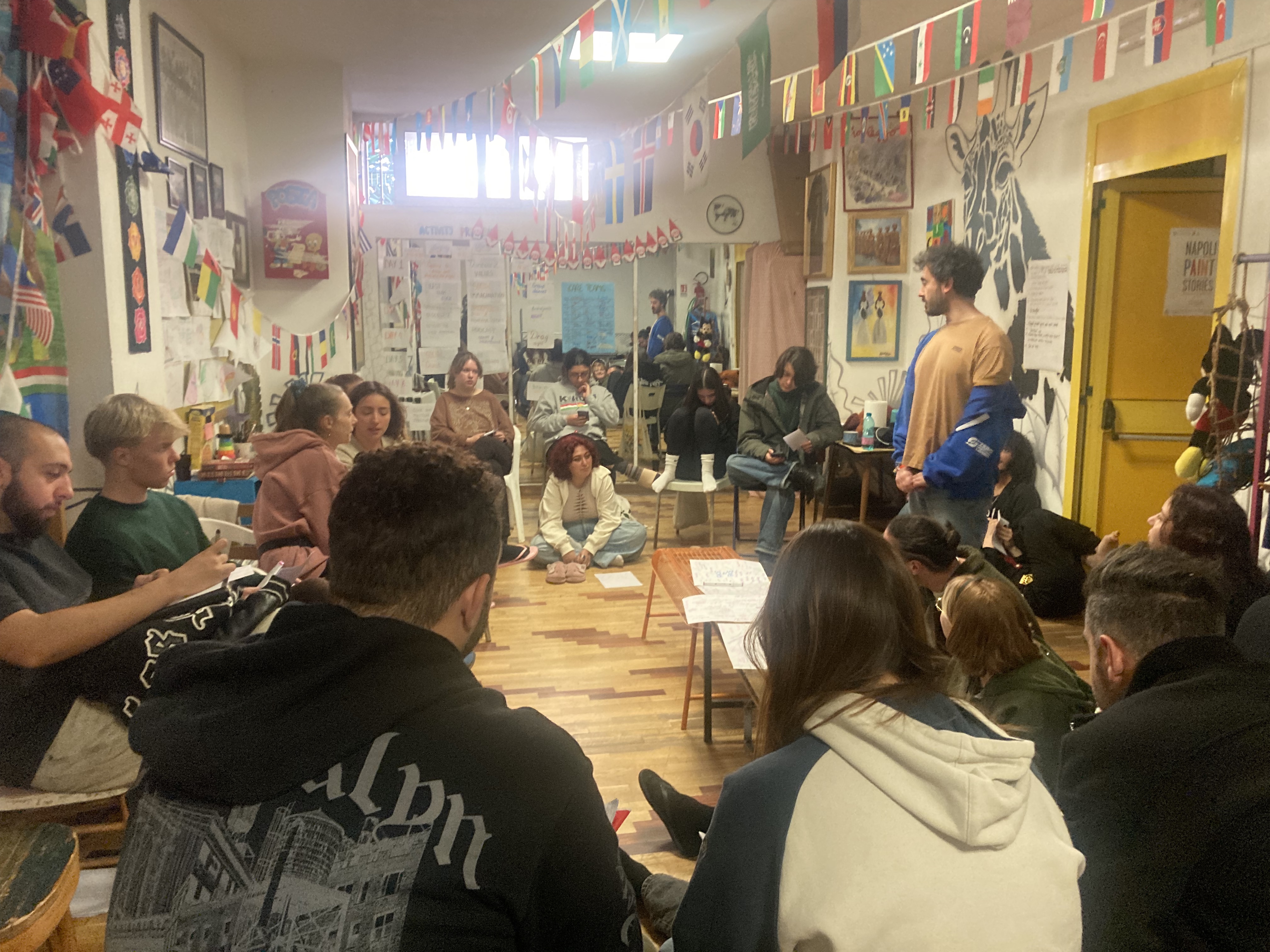
Activities from morning to night
Sofia Lobakina and Matteo Sisto, with their heart and solid experience, guided the participants to conduct research, evaluate media critically and identify rhetoric in political speeches. The World Café method increased understanding of propaganda, hate speech, populism and conspiracy theories. Debating was practiced by defending and opposing democracy. One day, we traveled “beyond the West” with the Peace Defenders’ media education materials.
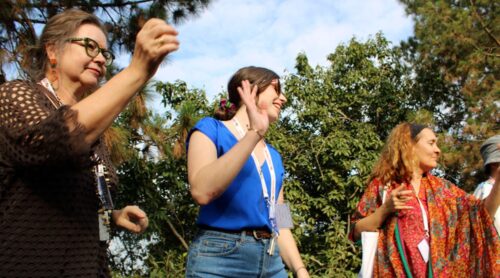
The group’s spirit was improved day by day by various energizing exercises, a gossip box with revelations every night, and evenings that were organized by the participants. The evening activities included events such as a culture night, drag night, skincare session, and a passionate courtyard dance on the last night.
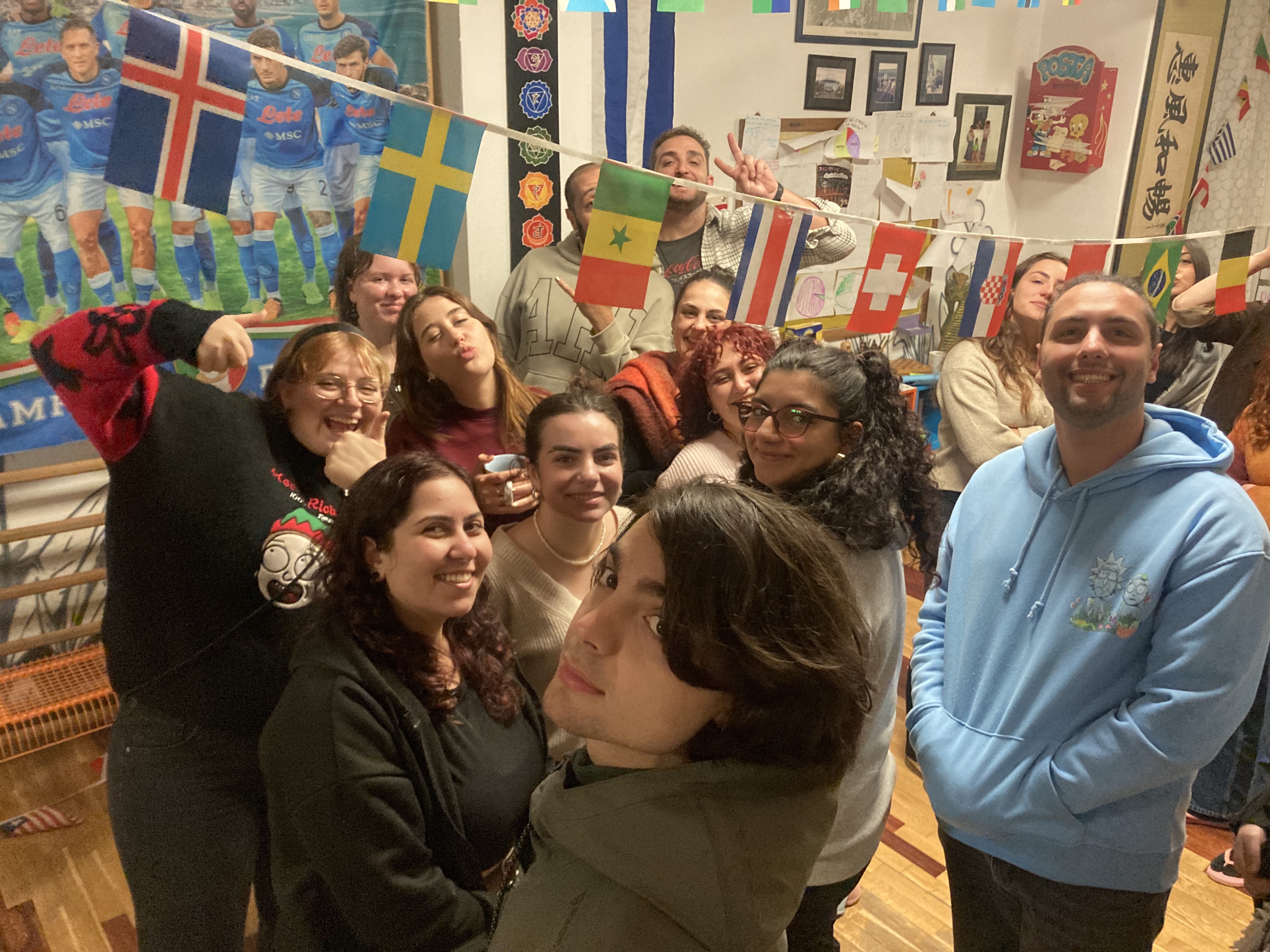
Dedicated atmosphere
The young people who participated in the project were between 18 and 25 years old and came from a variety of backgrounds. Some had a long history of activism, while some were just starting to become socially active. It was interesting to watch how people with different temperaments, skills, knowledge, and levels of English coped with group work. Apart from minor crashes, the interaction between the group seemed more relaxed and closer every day. There even seemed to be some love in the air…
The cooperation between the coordinators was both smooth and fun. Therefore, it was decided to apply for funding for joint projects in the future as well. Many said they would love to come to Finland – especially in the cool summer weather.
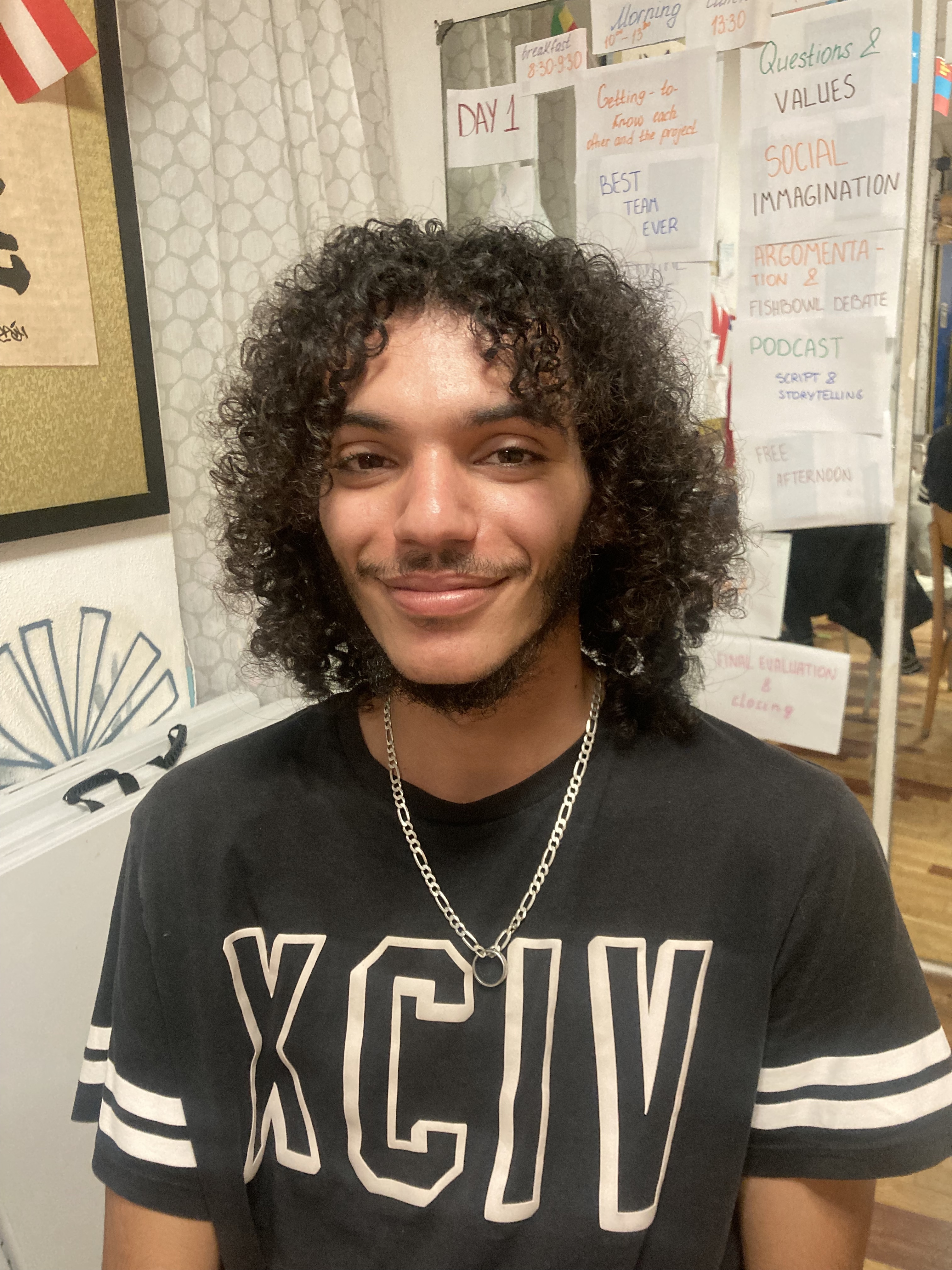
Mohamed Ben Mussa, 20, from Granada, Spain, is studying business and works as a youth worker. He has already participated in four Erasmus+ trainings. Mohamed found the Age of Discontent week to have well-planned activities, a really good vibe among the group, and an atmosphere where people were able to share their thoughts openly.
Mohamed is particularly interested in politics. In Spain, he has been involved in anti-racist and feminist activism in particular. He would like to challenge the linear course of life, where you progress from school to school and follow a certain career path. Mohamed believes that non-formal learning and living in communities are the spice of life. He claims that he doesn’t really dream about the future, but he would like people to have more control over how they spend their time. It would be great to live in a world where you could gather with others to do interesting things. In Mohamed’s ideal world, money and efficiency would not be top priorities. It would be okay to be slow and inefficient.
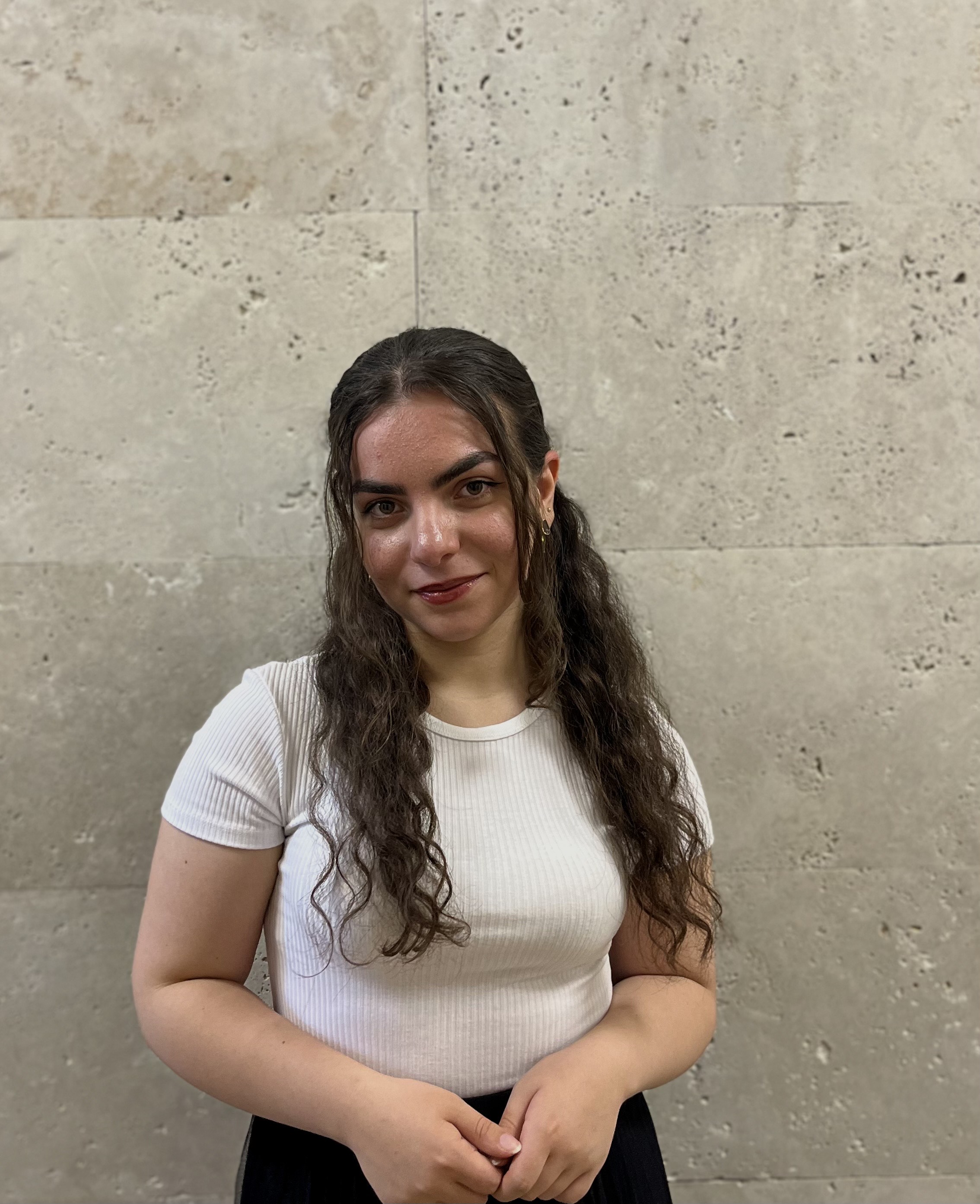
Emily Dolkhanian, 19, from Yerevan, Armenia, is studying English and communications at the American University. This is her third time participating in an Erasmus+ training. For example, she has previously participated in a course in Bulgaria that focused on sign language. During this project in Italy Emily particularly enjoyed making podcasts, and plans to continue making them in her home country.
In Armenia, Emily is active in an organization that focuses on improving the status of women. The biggest problems that Emily mentions for women in Armenia, sexual harassment and intimate partner violence, resemble those faced by Finnish women as well. Work is also being done to break traditional gender roles. In one campaign, people’s doorbells were rung and a discussion was started about the division of domestic labor and the future planned for girls. The activists encouraged families and their daughters to choose fields of study that deviate from the norm. Emily’s own upbringing was liberal, but many of her peers are still pressured to marry young, and in many ways to adopt the traditional female role.
Emily aims to become a journalist. She would like to better understand the logic of propaganda and fake news. Although she would like to study abroad, she thinks she wants to build her real career in her home country of Armenia.
What is Erasmus+ Youth Exchange?
An Erasmus+ youth exchange is usually a week-long educational event with participants coming from different EU countries. Some non-EU countries may also be involved. All participants’ expenses are covered.
The goals of the youth exchange are:
- to promote intercultural dialogue and learning
- to develop young people’s skills and attitudes
- to break prejudices and stereotypes
- to raise awareness of social issues and promote participation in society and democracy building
The song that you can listen to from player below is composed and written by Roope Koistinen.
English proofreading: Pihla Pulkkinen
Photos: participants of the Youth exchange